
At SpikeUp.AI, every student completes a capstone project proposed and supervised by a real company. These collaborations transform learning into practical, real-world experience and give organisations the opportunity to contribute directly to the development of new data and AI talent. Several companies partnered with us in 2025 and one of them was Artefact, a global leader in data & ai consulting services.
To share insights from this successful partnership, we interviewed Diederik Heijbroek, Machine Learning Engineer at Artefact, who supervised one of this year’s student teams.
About Artefact
Artefact is a global data consultancy specialising in data strategy, data engineering, machine learning, and digital transformation. The company works across sectors, from retail and finance to manufacturing and public services, to help organisations modernise and scale their data capabilities and processes.
Diederik explains:
“We not only advise companies on their AI strategy; we build and implement the solutions in their environments. So, we’re very hands-on.”

This expertise made Artefact an ideal partner to design a challenging, future-oriented capstone project for SpikeUp.AI students
The Project: “Talk to My Data”
Artefact proposed a project called Talk to My Data, designed to address a rapidly growing market need: giving non-technical business users the ability to access and understand company data through natural language.
What the system does
The concept is simple yet powerful:
A system where any user, particularly managers or business owners, can ask questions in plain language and have an AI model instantly translate those questions into database queries. No SQL required, no complex dashboards, no waiting.
This solution meets a clear demand in many organisations: fast, intuitive access to insights for non-technical teams.
To build the prototype, students worked with an open-source marketing dataset containing product categories, regions, prices, and sales channels. Due to governance constraints, real company data couldn’t be used, but the dataset provided a realistic business scenario for the students to work with.
To bring the system to life, the students had to:
-
- structure the dataset
-
- design clear database schemas
-
- connect the system to a language model
-
- ensure the model understands field relationships
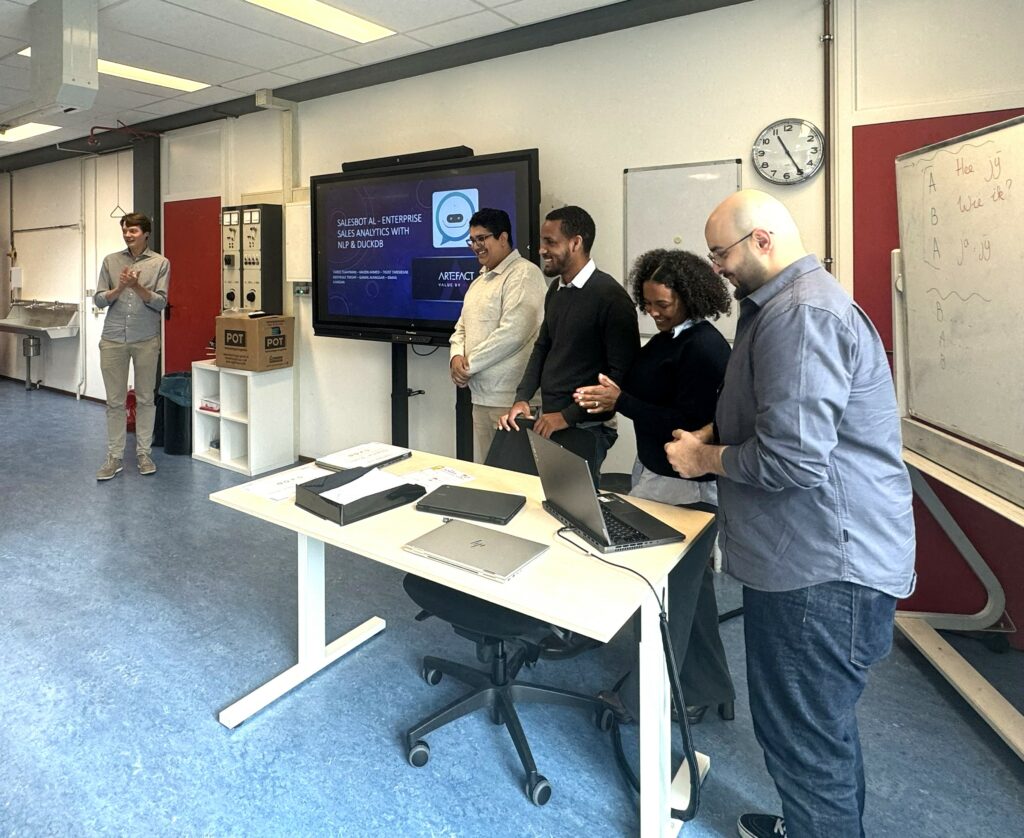
“They went beyond what we asked,” says Diederik. “They improved the interface by including visualisations, and they made the interaction feel natural. I was impressed by this”
A System That Can Adapt to Any Company
One of the project’s strengths is its adaptability. With minor engineering adjustments, the system can be connected to datasets from various industries, including retail, logistics, manufacturing, and finance.
“It’s not something we plan to commercialise as-is, because every client needs customisation,” Diederik notes. “But the concept is exactly the kind of solution companies are asking for today. And the students now fully understand how such a tool can be developed.”
Importantly, students retain ownership of their projects, allowing them to continue improving them after graduation. This type of system aligns closely with what many organisations, and Artefact’s clients, are currently exploring: data democratisation, self-service analytics, and generative AI to support faster and more informed decision-making.
A Motivated Student Team
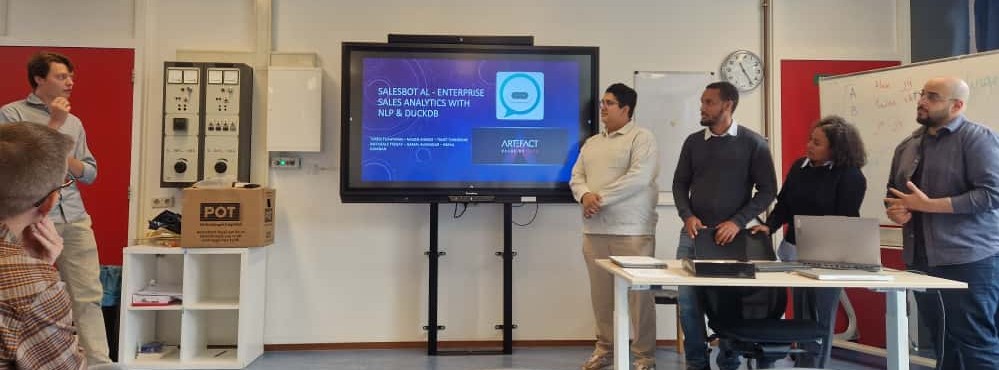
The team, Tgy Tarekegne, Tareq Tuaayman, Mazen Ahmed, Gamal Alnaggar and Mecheale Meisho balanced personal responsibilities, learning challenges, and language differences. Despite this, they demonstrated strong commitment and eagerness to grow.
“We spoke English as a group, and Dutch individually when helpful,” Diederik adds. “They were open, curious, and really wanted to improve. That motivation made the whole experience extremely rewarding.”
Weekly supervision included technical guidance, curated learning materials, best practices in data engineering, and ongoing feedback.
A Message to Future Partner Companies
Diederik’s message to potential partners is clear: collaborating with SpikeUp.AI brings real value.
“It’s a great learning opportunity, both technically and personally. The students are genuinely motivated and eager to learn. The time investment is small, much smaller than people might think. It never conflicted with my work. The students were grateful, engaged, and it felt meaningful to contribute”
Why Your Company Should Join Us
Partnering on a SpikeUp.AI capstone project allows your team to:
-
- Explore innovative ideas supported by fresh perspectives
-
- Mentor future data analysts, AI engineers, and machine-learning practitioners
-
- Support a purpose-driven program that accelerates refugee talent into the tech sector
-
- Contribute to broader social impact with minimal time investment
At SpikeUp.AI, we’re always looking for organisations ready to collaborate on impactful, industry-relevant challenges for our students.